
What should a good MMO's open world offer?
My perspective as a developer: PvE, PvP and a world that responds to players. Dynamic quests, territorial conquest and systems that keep danger from becoming abuse.
In this article4 sections
Translated from the Spanish original. Leer en español
The world cannot become just a lobby
If there is one thing I have learned over these years developing open worlds, it is that this is the most important feature and, at the same time, one of the most undervalued in some of the world's leading MMOs. The trend towards instancing parts of an MMO's content has taken a great deal of importance away from its open world. Ultimately, this turns MMOs into a lobby: you log in to a big city where everyone gathers, teleport into an instance, complete the content and return to the city. You rarely have a reason to get out and explore the world.
I want to set World of Warcraft aside for a moment and explain how I see an open world. My proposal rests on three pillars that need to coexist: PvE, PvP and a world that can change as a consequence of what happens in both. Completing content or conquering territory is not enough; players' actions need to leave a visible mark on the places they travel through.
I am not proposing a model where you can switch PvP off and focus exclusively on PvE. I mean one where conflict with other players is part of the world itself and cannot be avoided entirely. That does not mean there should be no safe zones.
PvE: actions need to leave a mark
On the PvE side, many current MMOs already do quite a few things well: quests, explorable areas, world bosses and even a kind of open-air dungeon. Some also include world events capable of transforming an area: a bridge being destroyed, a change in the terrain or a threat disappearing for a while.
A world that responds to players
Imagine an area overrun by trolls. If players defeat enough enemies and remove that danger, the world should respond: trade routes could open, prices in the nearby city could fall, or new settlements and camps could appear. None of this would have to be permanent. Over time, the trolls could retake the area, close the routes again and turn their return into a new event for players. Guild Wars 2 has explored this kind of dynamic consequence, and it is a good starting point for understanding the idea.
All of this helps the world feel changing and alive, and I think every MMO should embrace that idea. Players' actions in PvE need to be reflected in the world. The world cannot be static. It should not be if we want it to feel alive.
Beyond familiar quests
Beyond the quests we all know, the main storylines and side quest chains, there is still room to innovate. Some MMOs have already explored dynamic world quests: small events started by an NPC that turn a specific local need into a shared task.
Imagine a character who needs a certain number of apples picked from their orchard. The quest could activate for everyone inside the area, be accepted automatically when you enter and disappear when you leave. There would be no need to speak to the NPC first or work through a quest menu: the objective would be there, in the world itself, and everyone could work together to gather the apples needed. Each participant would receive a reward that reflects their contribution.
The same idea can go much further. It could become a quest to defeat enemies in a particular area, several objectives happening at once, or a situation complex enough that a player needs to find a group or encourage nearby people to help. The quest stops being an individual checklist and becomes something happening in front of everyone.
PvP: conflict as part of the world
Territorial conquest
On the PvP side, I believe there need to be capturable areas: forts, castles and other strongholds where control has consequences. Conquests that change trade routes, the resources you can obtain and even the benefits available to your entire faction. For example, controlling certain forts could increase the reputation or experience its members earn.
Safe cities and zones are important, of course, but so are disputed territories and outright war zones. That distinction needs to be part of the world you travel through: you can have a place to return to while forts and castles beyond that refuge remain contested between factions.
Alongside capturable strongholds, there could be large PvP events that trigger automatically: capturing a city in a war zone, fighting over a bridge or answering a call to war because your faction needs you. Cities designated as safe would be excluded from these conquests.
These events need to offer good rewards. If a faction conquers an area, it should be able to hold it for hours and enjoy tangible benefits: new merchants, access to items, discounts and other advantages tied to that conquest.
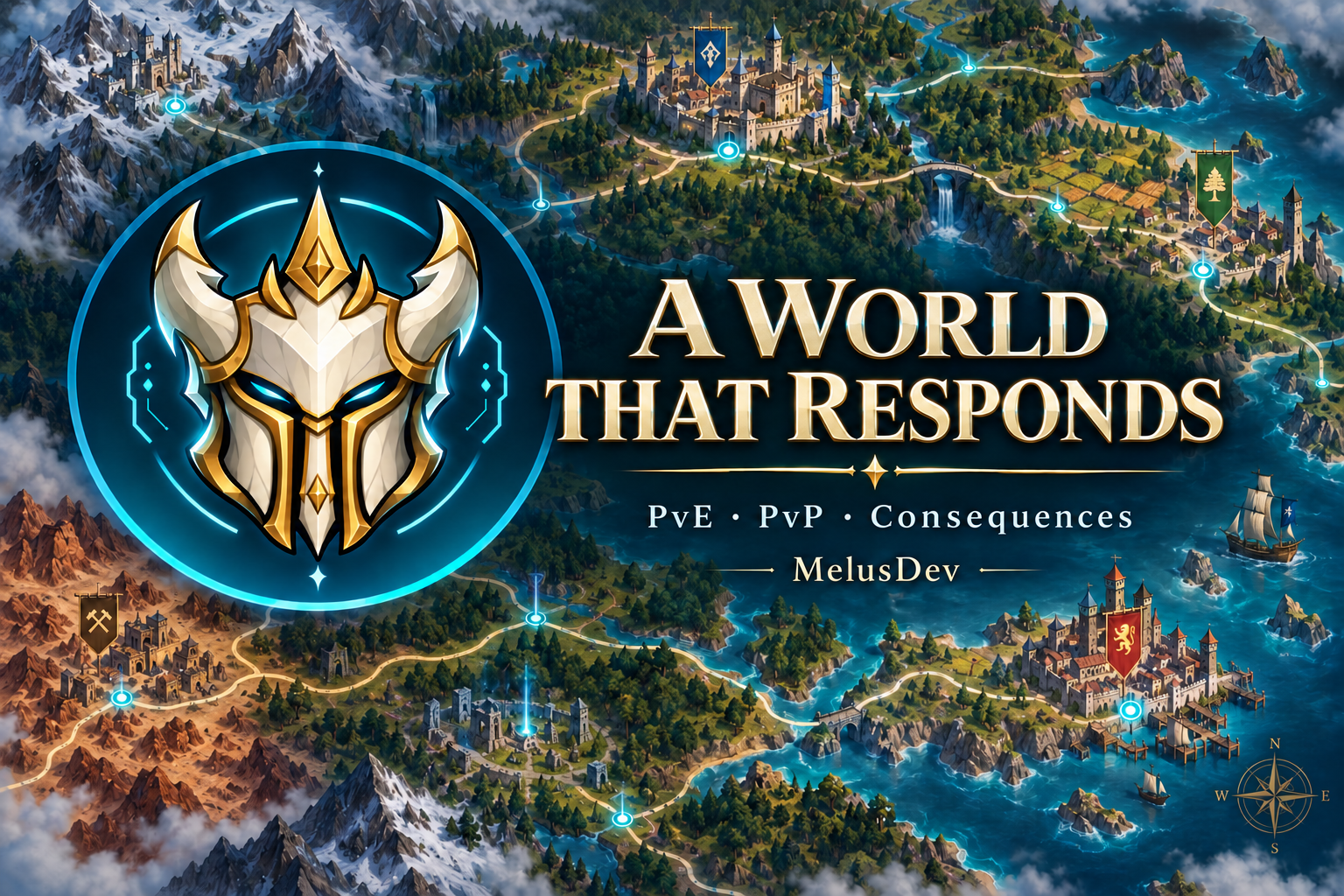
What matters is that the effort is felt throughout the faction, including by people far from the fighting. In the map example, capturing a fort grants a reputation bonus, and controlling a second stronghold adds an experience bonus. Losing that second stronghold removes its bonus, while the bonus from the fort still under our control remains. The percentages are only illustrative: the point is that conquest should matter, and defending what you have gained should matter too.
The world should be dangerous, but not unfair
Players can encounter members of the opposing faction as they travel through the world and be attacked by them. And that is fine. Within reason, a virtual world tries to represent a reality of its own, and the danger of running into another player is part of it.
Dying while levelling can be frustrating, of course. That is why we need systems that prevent excessive camping and protect players from abuse without removing risk altogether. If we want to preserve the essence of a pure MMO, turning the entire world into a place without danger should not be an option. (I know many MMOs have removed this kind of PvP, but here we are sticking to the idea of an MMORPG.)
One possibility would be a villain system. When a player repeatedly kills others, especially if they prey on lower-level characters or keep camping an area, the world itself starts identifying them as a threat. Their name could appear in regional warnings, a bounty could be placed on their head, and other players would have a reason to hunt them down. The further they take their behaviour, the greater the bounty and the consequences of being defeated. The game would not prevent someone from playing a villain, but it would turn their actions into content for the rest of the community and make the world itself respond to abuse.
Escort systems could also be introduced for lower-level players. In areas where camping or a sustained presence of much more experienced enemies is detected, intelligent NPCs could temporarily accompany a player, defend them, heal them and fight alongside them. This would not have to make the player invulnerable: raising the risk for the attacker and discouraging them from targeting an easy victim would be enough. The world would remain dangerous, but it would respond when that danger becomes abuse.
My vision of an open world
Ultimately, these are very broad ideas. We could go much deeper into each one, explore smaller proposals and examine all those details that eventually give a world its shape. But, in broad terms, this is my vision of the minimum an MMO's open world should offer.
Best regards, Dani.
YOUR TURN
What makes an MMO world feel alive to you?
The conversation continues beyond the blog. Tell me what you think on X.
If you enjoyed reading this, you can buy me a coffee.
Buy me a coffee